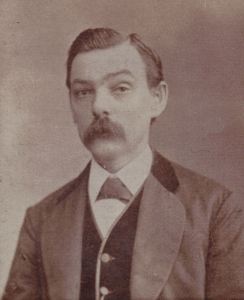
Using Geneteka to Find Polish Records

Another Post About Ernst Heinryck May (1878-1951)

I recently started a database do-over. I have many pieces of uncited information, many documents stashed all over my DropBox, and it all could use some organization. So, I adopted a form I found online, and, with my Big Book of Records in hand, methodically started organizing my hard copies and my digital copies and making a list of all I have and what I still need to find. The list looks something like this:

I have the Ahnentafel Number of the individuals, but I have hidden it here. The RM-ID is the ID number that they are assigned in my RootsMagic software. I also included hyperlinks to where the documents are found on my DropBox. In my DropBox, the documents are labelled correctly and tagged with the subject of the document:

This little clean-up project led me to a mystery entry in my old database: I had Ernst’s baptismal date but no citation for it. Or a document for it. Or anything. So where did it come from?

I started combing through my usual sources for Polish records but was coming up empty. Then I remembered Geneteka. Geneteka is a database hosted by Polish Genealogical Society website. It is the biggest database concerning Polish genealogy, which contains over 30 million indexes from many regions of Poland. The database and its indexes are prepared by volunteers. In the past, the main source of indexes were year-end indexes. And it is FREE.

I plugged my Great Grandfather’s name into the search engine, the location where he was baptized, limited it to the year he was born, and hit Szukać (search in Polish). Note – you can view the website in English. Nothing came up.

Undaunted, I pulled up all the records for Löbau for 1878. I knew it was there. It had to be! And there, magically, the eighth entry had my Great Grandfather’s first and middle names, with his mother’s maiden name as his surname.

Now we’re in business! I clicked to the far right of the entry, where it says “skan” and was rewarded with this:

All of those numbers are hyperlinks to scanned pages. The register itself starts in 1878, so I knew he would be near the front of the book. So, I just started looking at each page. They do not correspond to the numbers indexed on the Geneteka search results, so you need to be diligent.

The document I found was this:

I could make out the name of the town, names of the parties, but little else that wasn’t printed Fraktur. The handwriting was, at best, difficult. I put out a plea on Facebook – one to my personal page, and one to the wonderful group at Genealogical Translations. Was I correct? Was this his baptismal record?

The short answer? No!

I was told that it was a birth record for him, and that he had been born illegitimate! The handwritten info to the left of the actual entry is a notation that the father (my 2nd Great Grandfather) married the mother after the birth of my Great Grandfather. Quite the scandal!

My next reward came when I saw the name Ignatz Olszewski written in there. That, it turned out, was the next generation back on my tree – my 3rd Great-Grandfather!

I entered the name Olzsewski into Geneteka next, limiting it to Löbau. The first record I found was the marriage record of my 2nd Great Grandparents.

This led to more questions. My 2nd Great Grandmother is listed as Clara Sandkowska, not Olzsewska. What was going on? When I pulled up the scan, I could easily see what happened. The transcriptionist had put Clara’s mother’s maiden name instead of Olszewska:

The new find of Clara’s parents’ names led me to two 2nd Great Granduncles and their marriages.

As I continue to research my Polish family ties, I will use Geneteka more often, and hopefully, uncover more information about my family!

Posted in Polish | Tagged , , , | Leave a comment

Just in Time for Easter: Going Down the Rabbit Hole

I attended a webinar today, and it inspired me to use the FAN method (Family/Friends, Acquaintances and Neighbors) to help me answer one of my long-standing questions: Why did my Great-Grandfather immigrate to the U.S. by himself at the age of 10?

Ernst Heinryck May was born in 1878 in Biezun, Poland. He arrived in New York on April 8, 1888. He was naturalized in 1904, and his naturalization was witnessed by two men: Edward Labedz and Konstantine Twarogowski.

“Records of the Immigration and Naturalization Service,” digital images, National Archives and Records Administration (Washington, D.C.), District and Circuit Courts, Northern District of Illinois and Immigration and Naturalization.

I decided to try to find out if these three men knew each other, or if they were just in the right place at the right time.

First, I decided to look both men up on the 1900 and 1910 censuses. I found Edward on the Censuses from 1900 up until 1930, first in Chicago, IL and then in Portsmouth, OH. I found his passport application, on which is listed his place of birth as the same small town my Great-Grandfather was born in: Biezun, Poland. Interesting!

Next I looked up Konstantine Twarogowski. I found the ship’s passenger manifest when he came to the U.S., which listed his last permanent residence as Biezun, Poland. Even more interesting! I was able to find both men’s naturalization records, but my Great-Grandfather was not a witness for either of them. But, they were all granted naturalization between October 14, 1904 and November 3, 1904.

So these three men came from the same small town in Poland, all immigrated to Chicago, IL, and were all naturalized within 14 business days of each other in 1904.

I looked into Edward a bit deeper. He was listed on the censuses as a cabinet-maker, a brick-layer, and a contractor. My Great-Grandfather was a carpenter, and family history has it that he also helped to build Bryn Athyn Cathedral in nearby Huntingdon Valley, PA (although I have not yet been able to confirm this legend). Konstantine appears to have been a baker. So two of the men were in the same line of work.

I followed Edward’s line down to present day descendants and was able to reach out to and make contact with one on Facebook. Side note: This. I am this level of obsessed with genealogy, folks! All of this within a few hours of the presentation which got me to wondering if my Great-Grandfather had a connection to the men who were witnesses for him, or if they had just been pulled off the street on November 3, 1904.

My new Labedz family contact couldn’t confirm that our families knew each other. In fact, he didn’t even know his ancestor came from Biezun. He is sharing the photos I sent him and the Słownik Strat Osobowych Gminy Bieżuń w Latach 1939-1947 booklet with older members of his family, which also lists Labedz family members who were killed during the Soviet occupation. Maybe they will have some clues?

I haven’t had the same luck with Twarogowski descendants. I will keep trying and playing with the surname spellings!

I also sent a quick note off to my cousin in nearby Rypin to ask if she had heard of these families.

I may never know why my Great-Grandfather immigrated at the age of 10, but I can speculate that it was some type of carpentry apprenticeship for him. It had to have taken a lot of courage to leave his home at that age and work to bring the rest of his family to the U.S. Since we do not have the 1890 Census to go by, I don’t know where he stayed, or who with. You would think a boy of 10 would need to be staying with a family. By 1900, he was in Philadelphia, PA, and living a life of his own.

Family/Friends, Acquaintances and Neighbors: Check them all out in your genealogical efforts – you never know when something interesting will turn up!

Posted in Uncategorized | Tagged , , , | Leave a comment

The Kotlarek Project

Back in the early 1990’s (last CENTURY!), before the Interwebs became as easy to access information on as it is today, there was a handy publication for finding people called a telephone directory. Back then (when I walked both ways to school barefoot and up-hill), one could purchase the telephone directory for the U.S. on a set of CDs. I know, it sounds as far-fetched to me today as it does to you. But so it was, AOL was still dial-up, Ancestry.com was just being developed, Family Tree Maker was made by Brøderbund in its earliest stages, and genealogy was done on paper.

I was working on my Polish lines with little success. Something my Uncle said to me decided me to work on the one surname: Kotlarek. My Uncle said to me, about our family, “You know, there is a famous skier in our family, Gene Kotlarek,” and he showed me some news clippings he had. He didn’t know HOW we were related, but he thought surely, we must be.

Research Question: Are my Kotlareks related to Gene Kotlarek, the famous skier?

To determine if this was true, I had to know more about the Kotlarek family. I took out my telephone directory on CD and proceeded to write a letter to every Kotlarek in the U.S. Results were mixed: some people responded, most did not. I was able to round out my immediate family that was largely local to me, but not so much the other families. Back then, finding your Polish ancestry beyond immigration was not an easy or inexpensive task. Not to mention, I was inexperienced at best.

Recently, with the current pandemic, I found myself with more time on my hands than I had in a long time. So, I decided to re-investigate my Kotlarek lines and see what I could find. Not being a common surname, I decided to systematically find the progenitor of the family, to see if all the U.S. Kotlareks are related.

Research Question: Are all the U.S. Kotlareks related?

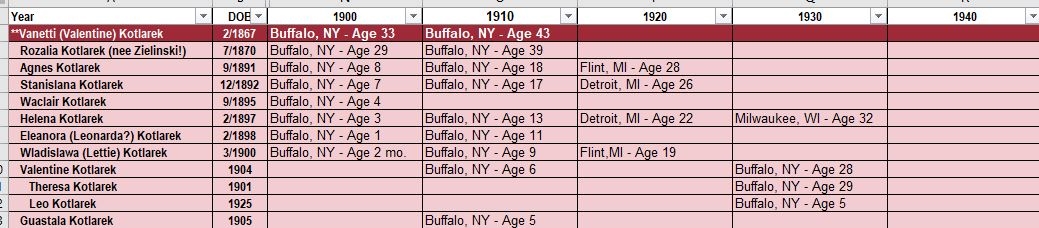
My first step was to create a form in MS Excel. I took a Census Tracking form and adapted it to my needs. In the first column, I would list the names, and in the next several columns, the years of the censuses, the city and state of where they were found, and their ages:

snipofexcel

Example of Census Tracking Form used in Research Project.

Then I began combing through Ancestry.com. On the Search menu, I narrowed my search to Census and Voter Lists. I then plugged Kotlarek into the Surname box and clicked Search. At this point, I wanted a rough idea of which family units were where and when. I already knew there seemed to be a group in the central states from the old telephone directory, but I did not have a good visualization of the concentrations.
The oldest result was Valentine Kotlarek on an 1895 Wisconsin Census. I set that aside for now. No other results were from before 1900.

The 1900 Census. The gem among gems: Names. Birth months and years. Marriage years. Immigration years. A potential gold mine of information! Of the 32 results I received of individuals, they all belonged in three family units: one in Buffalo, NY; one in Milwaukee, WI; and one in Cleveland, OH. I recorded this on my altered census tracking form. Then I moved onto the 1910 Census, and within an hour or two, I had data from five censuses and 187 names.

The names broke down into eight major family units and several outliers with the clusters in Detroit, MI; Duluth, MN; Milwaukee, WI; Buffalo, NY; Cleveland, OH; and my East Coast group. My next step was to identify which people immigrated to the U.S. This was easy since it was the original heads of household. I looked for their immigration records and death certificates online and was able to identify some of their parents’ names.

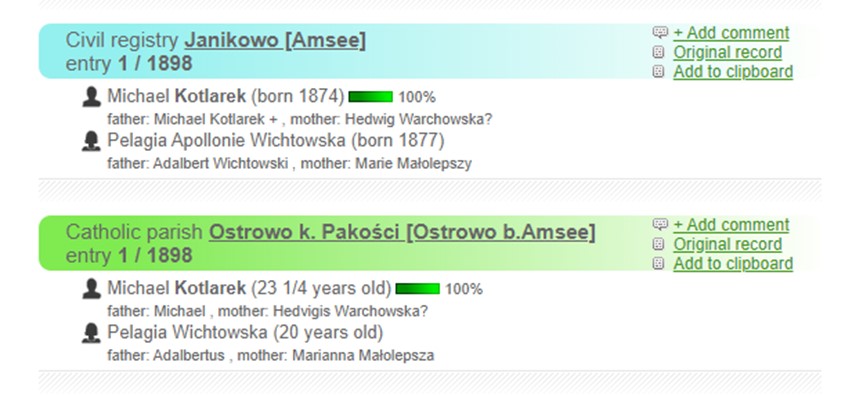
Next, I looked for the immigrants and their parents’ names on The Poznan Project and BaSIA Famula to see if I could find them in Poland. By following these steps, I was able to identify the parents of the eight patriarchs, and yes, some of them were brothers.

PPscreengrab

Two entries on The Poznan Project for some of the families I was looking for.

Next, I turned to my Ancestry DNA Matches. On my main DNA Match screen, I searched for the surname in my matches’ trees. I found ONE match, at 7 cM, J.L. I contacted J.L. and we were soon emailing back and forth and sharing information.

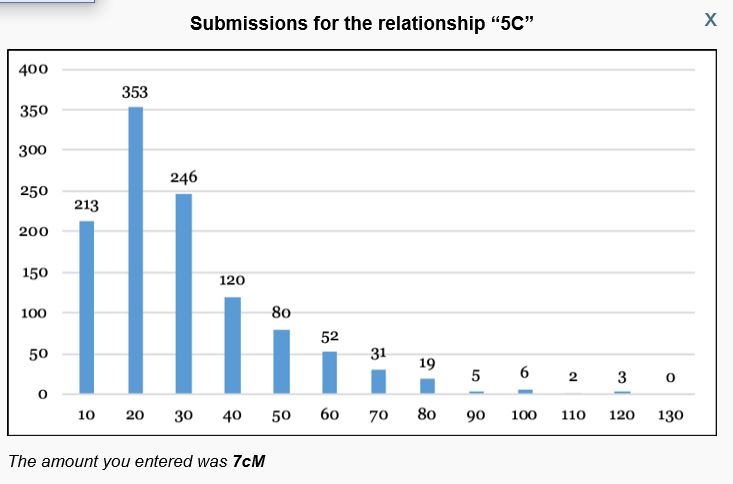
J.L.’s ancestor is one Joseph Kotlarek. I already knew Joseph and his wife, Maria Zdrojewska were the parents of two of my groups. I theorized that if Joseph was J.L.’s 2nd Great Grandfather (as per J.L.’s tree), then perhaps Joseph and my 2nd Great Grandfather Jakob were brothers. That would make us 4th Cousins. I checked the Shared cM Tool and plugged in 7 cM. When I saw the results of the bell curve, I deduced that Joseph and Jakob were likely 1st Cousins, not brothers. When I checked the result for a 5th Cousin, J.L. and I fit perfectly on the bell curve. (Note: to learn more about using the bell curve at The Shared cM Tool, please see Blaine Bettinger’s article, “Version 4.0! March 2020 Update to the Shared cM Project,” (and subscribe to Blaine’s blog while you’re there!)).

5C

The Bell Curve from The Shared cM Tool at DNAPainter.com for 5th Cousins.

I checked my sister’s DNA on the off chance she had another Kotlarek match that I didn’t. She did, of 8 cM, J.K. J.K. also matched my first cousin, D.K. I emailed J.K. examined J.K.’s online tree. J.K. was descended from Michael Kotlarek and Hedwig (Jadwiga) Warchova, whom I also had already identified on my list of Kotlarek’s. Since J.K. matched my sister and my first cousin, Michael and Hedwig’s descendants also had to be of the same family.

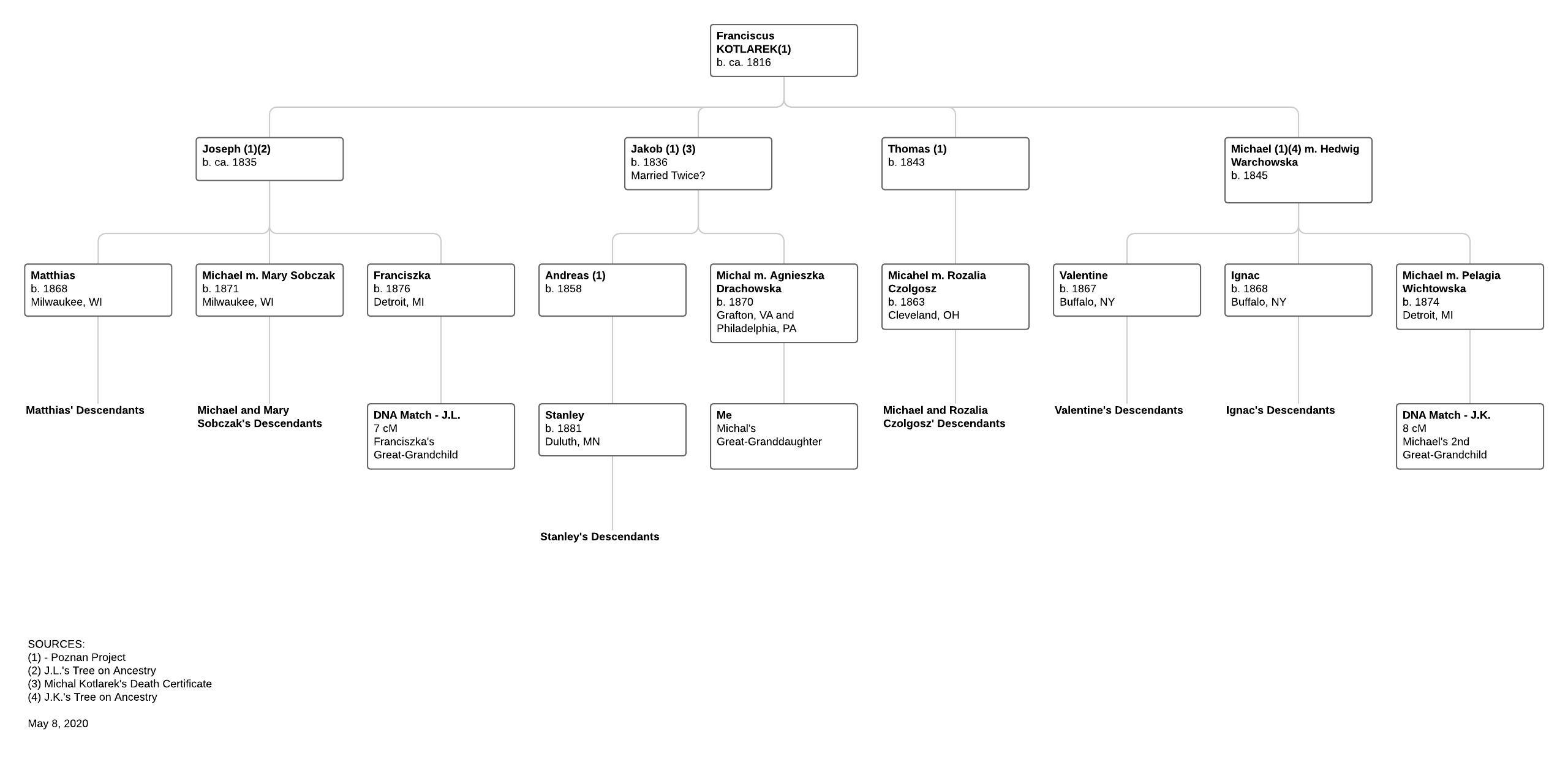
I now have a tentative tree that looks like this:

Kotlarek Family Tree (1)Within 24 hours, I was able to tentatively link five of the eight major family groups to ONE Kotlarek ancestor (including my own progenitor)! Now, I know this is not PROVEN, and I may never have actually proof, since it’s buried somewhere in a Polish archive, but I am feeling pretty good about it.
Ongoing Research

There were two contacts on The Poznan Project on some of the people I was looking for, so I emailed them both. One I was able to connect with right away – her Kotlarek ancestor was one who married into her family. The email bounced on the other contact. I will continue to investigate and research our families, to see if I can find solid proof to answer my research questions, and to merge the Duluth, MN and Cleveland, OH lines with mine. I will be posting an update to this article.

If you are a Kotlarek descendant, or know one, please ask them to join The Kotlarek Project. Also, please consider testing your DNA with Ancestry.com, and please connect with me here.

Click here for a previous post I wrote about my ancestor, Jakob Kotlarek and using DNAPainter.com.

Posted in Uncategorized | Tagged | 1 Comment

Barking Up The Wrong Tree

dog

Here is a portrait of me since the last time I wrote.

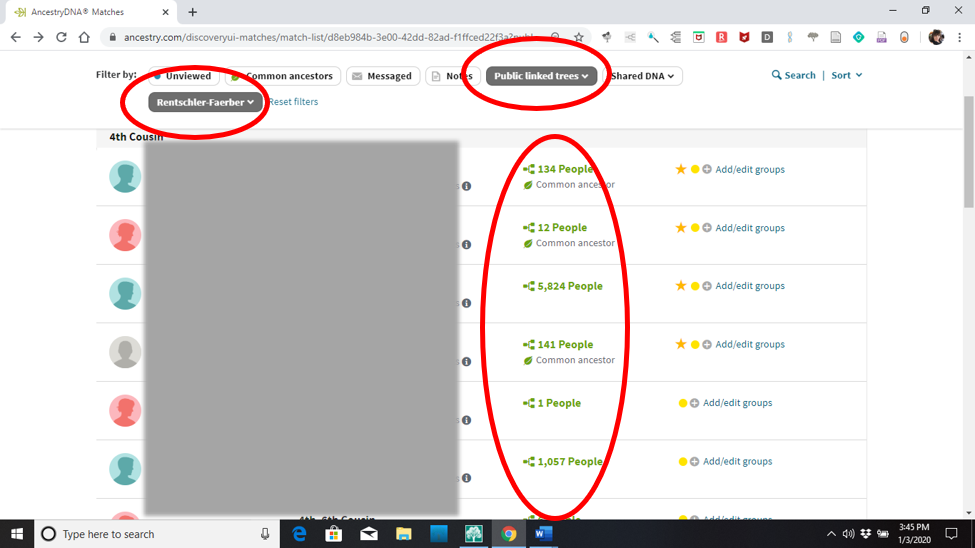
I last wrote about working through DNA matches and building out their trees to try to find the link. In the process of doing that, I STILL couldn’t figure out where I linked up with my Rentschler DNA matches on the 4th-6th cousin level. DNA told me they were there, we shared the surname (well, some of us, more on that in a minute), but I couldn’t find the link that tied us all together.

Until I started going over my OWN tree.

My Civil War ancestor, Georg Rentschler, lived in Philadelphia, PA. and died in 1885. I had thought his father was one Johann Jakob Rentschler, when it turns out, I had missed an entire generation. After slapping my forehead a few times, I realized that the father was Jakob Friederich Rentschler, and then all of the pieces fit – including the relationship predictions on my Ancestry DNA match list. So for about two years, I had the wrong man, and it turned out I didn’t vet my own information well enough!

That is the lesson today: If something in your tree doesn’t make sense, review your OWN data first. You are only human, and could be wrong, or made a wrong assumption (easy to do when you have several people with the same names in your tree!). Now, some of my matches still have incorrect data (i.e., the “time travelers”), so anything I see on their trees should be used as CLUES, not fact, until I can vet it on my own to my satisfaction.

Of course, now that I have THAT puzzle straightened out, another one arose. One of my 5th – 8th cousin matches has a nice-sized tree, but we had no common surnames. Except … the one surname was Rentz. Hmm… Rentz, Rentschler … it’s not a far leap. So I started combing through her tree and found that her Rentz ancestors were in the same small area of Baden-Württemberg, Germany (specifically, right around Calw) that mine came from. I haven’t found the link – yet. She triangulates with my other Rentschler DNA matches. Did Rentschler get shortened to Rentz during immigration, or was it further back than that? Feuding family members? The possibilities are endless!

I’ll keep you posted. In the mean time, I’ll try to keep from barking up any more wrong trees!


Posted in Uncategorized | Tagged , | Leave a comment

Working with DNA Matches – Using Pedigree Thief to Work Your Matches

If you have followed along from my last post, you may have spent the last few weeks color coding your Ancestry.com matches into groups. Now that you have them grouped, what do you do? You start looking at their trees and seeing where you may connect! The DNA matches who have a common ancestor are easy – you know where they connect, through your common ancestor. But what about the people who don’t? That is what we are going to work through here.

As I stated in my last post, I like working with these matches through the Chrome internet browser. There is an extension for the Chrome browser called Pedigree Thief – and you should install it if you don’t have it. If you need instructions to install it, scroll to the bottom of this post.

Now that you have installed Pedigree Thief, let’s get to the fun stuff!

  • Open a word processing document on your computer to have at the ready.
  • Go to Chrome and load your Ancestry.com DNA matches.
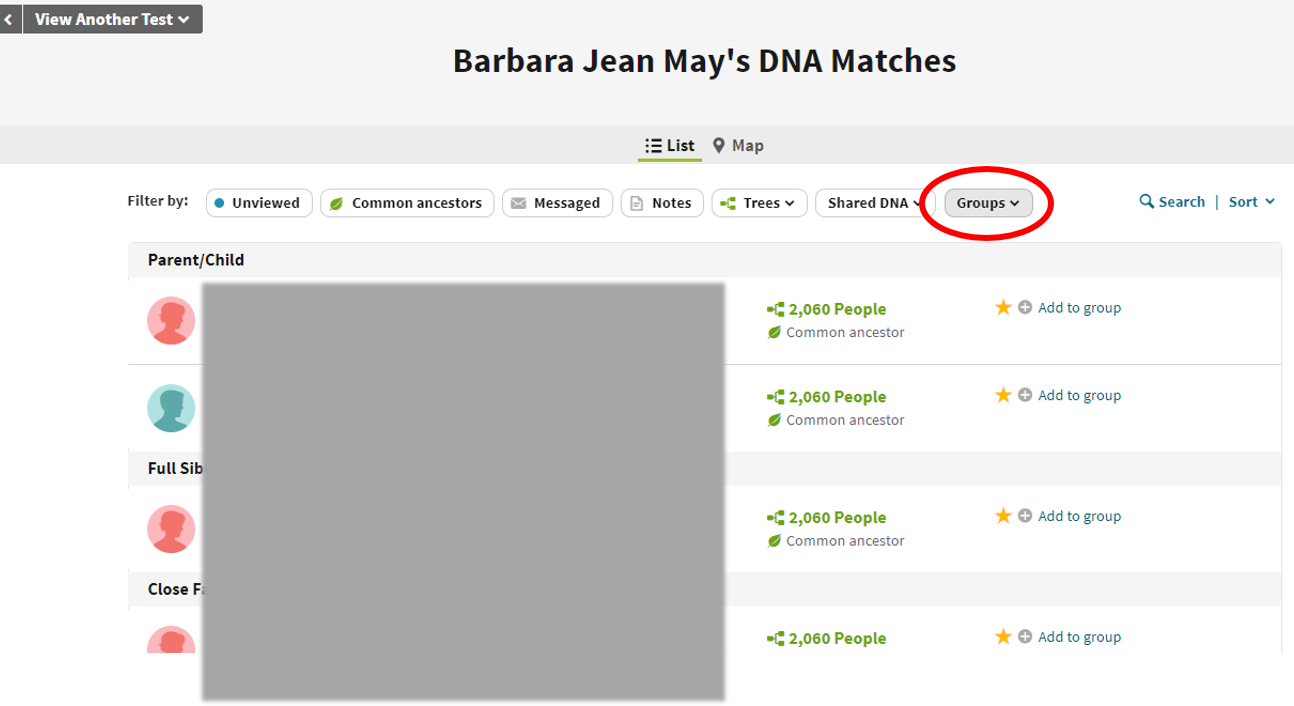
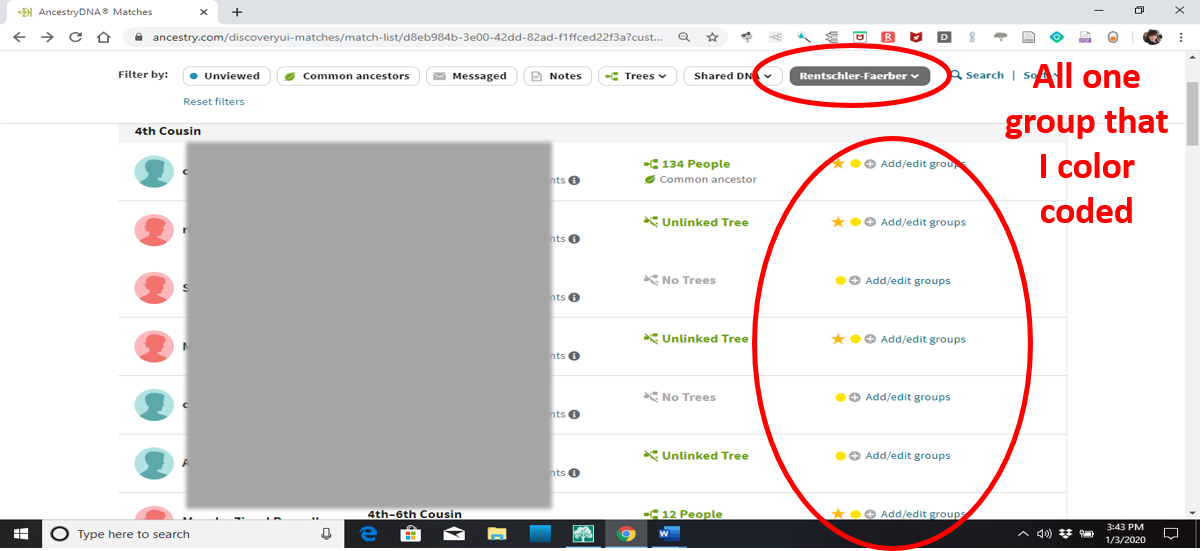
  • Click on Groups and select the grouping you want to view

blog1

  • Select “Apply”. Now only the matches in the color-coded group appear.

Blog2.png

  • Next, go to the Trees Menu and select “Publicly Linked Trees” or “Unlinked Trees.”

Blog3

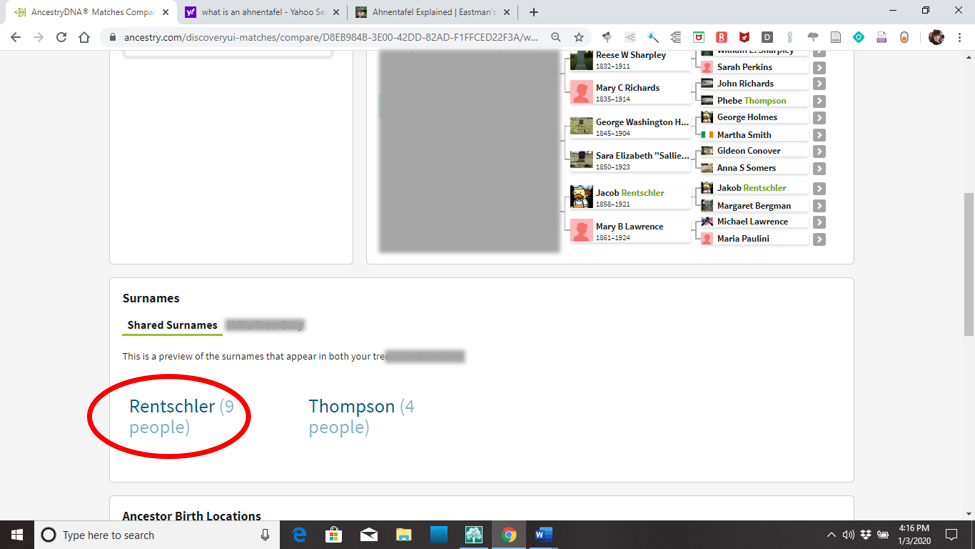
  • Go to the first match who has a tree, who you do not know how they fit into your tree. The first thing I do is scroll down to see the surnames that appear in both of our trees:

new1

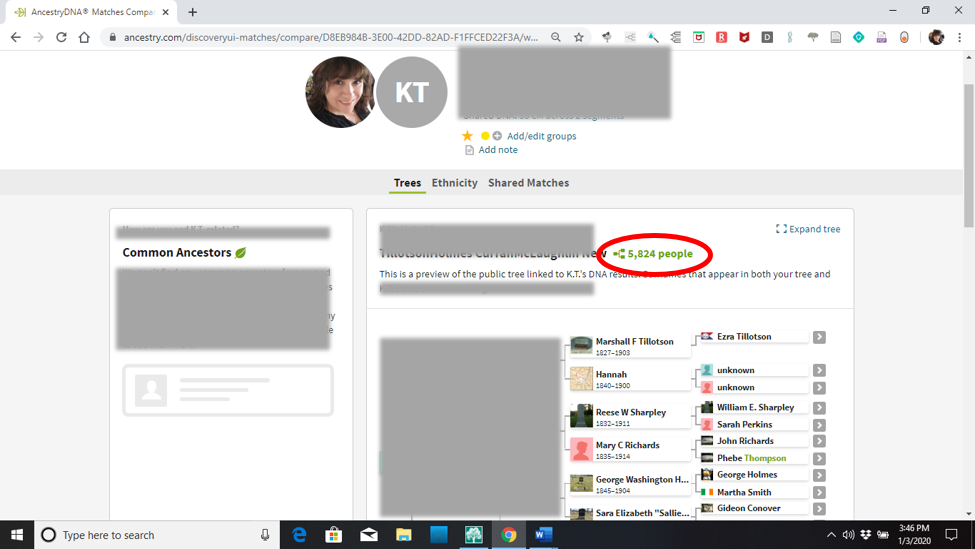
  • Then I scroll back up and click on the green Tree link to expand the tree – we want to see the entire tree for the next step.

blog5

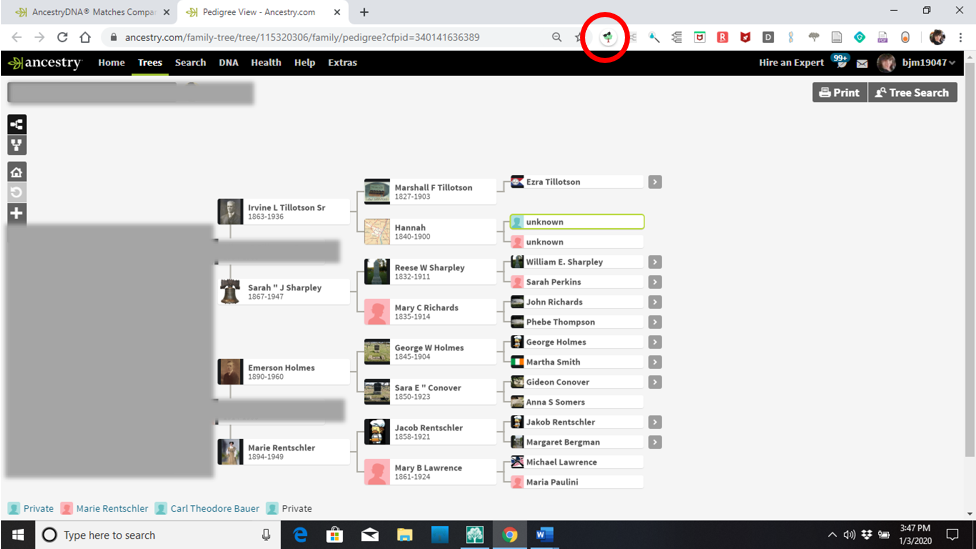
  • A new window will open with a pedigree chart for the DNA match (i.e., the DNA match is in position number 1 on the pedigree chart).
  • At the top of the screen, click the Pedigree Thief button twice.

new2

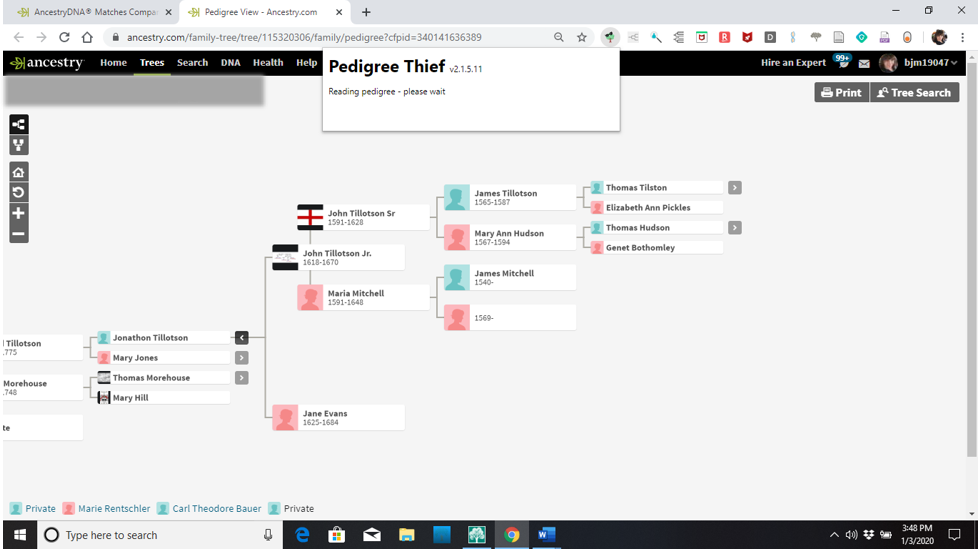
  • The screen will begin to animate, and you will see a pop-up that tells you that Pedigree Thief is reading the tree.

blog7

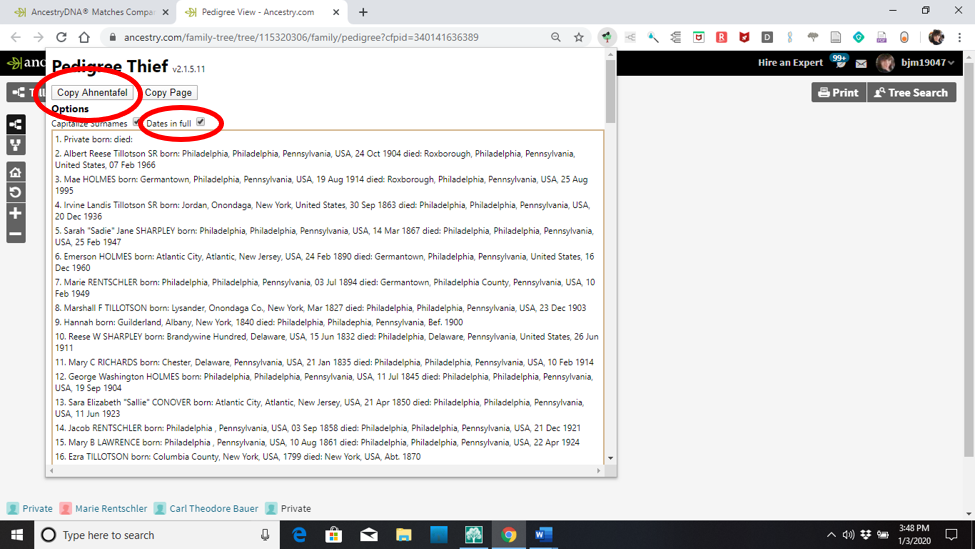
  • After a moment, Pedigree Thief opens a window like this:

Blog8

  • First check off “Dates in Full”, then select “Copy Ahnentafel.” Paste into the word document that you opened.

Now you have a numbered list (or, Ahnentafel Chart) of the DNA match’s tree from Ancestry.com, that correspond to the numbers on a pedigree chart. (If you are unfamiliar with the Ahnentafel Genelaogicial Numbering System, you can learn about it here).

But wait! There’s more!

Say that you have explored this person’s tree and recognize another surname from another DNA Match. You can move that person to position number 1 and follow the steps above to create another Ahnentafel Chart from the same tree!

Working through each of the matches that have a tree, you can copy down their trees in this fashion, and try to work out where your trees merge. Some won’t have any common surnames – you can create a “quick and dirty” tree for them and try to work their branches back to the common surname. Some Ahnentafels will be quite long – you can eliminate all information past the last time your common surname appears.

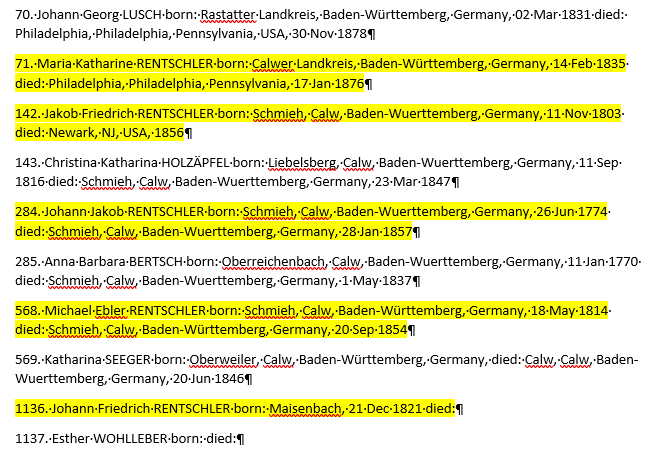
Remember to use your results of this as clues, and research them well. I have found incorrect trees, so the information must be vetted before adding it to your own tree. In the example below, I deleted out the information I didn’t need (i.e., other branches of the family that are not related to our common branch), and found some time travelers. See if you can spot them (Remember, the higher the Ahnentafel number, the further away in time they are):

Blog9

Using this method of “lifting” trees, you can easily browse through to find where you all tie together before adding to your own tree.

What methods have you used to work with your DNA matches? Comment below!

How to Install Pedigree Thief:

  • Launch Chrome, and search for “Pedigree Thief Chrome Extension.”
  • Click on the link that says, “Pedigree Thief – Chrome Web Store.”
  • On the right-hand side of the screen will be a large button that says, “Add to Chrome.” Click the button.
  • A pop-up will ask if you want to add it. Select “Add Extension.”
  • After a moment, it will tell you that this extension has been added to Chrome, and the utility bar across the top next to the Internet address will show this icon: Blog10
  • Note: When you are NOT on a page that shows a family tree, the icon will be grey.


Posted in Uncategorized | 4 Comments

Working with Ancestry DNA Matches

A few months ago, Ancestry released a new tool for grouping DNA matches with color-coded dots. I watched a few videos of how to do this to gain maximum results and have come up with my own method.

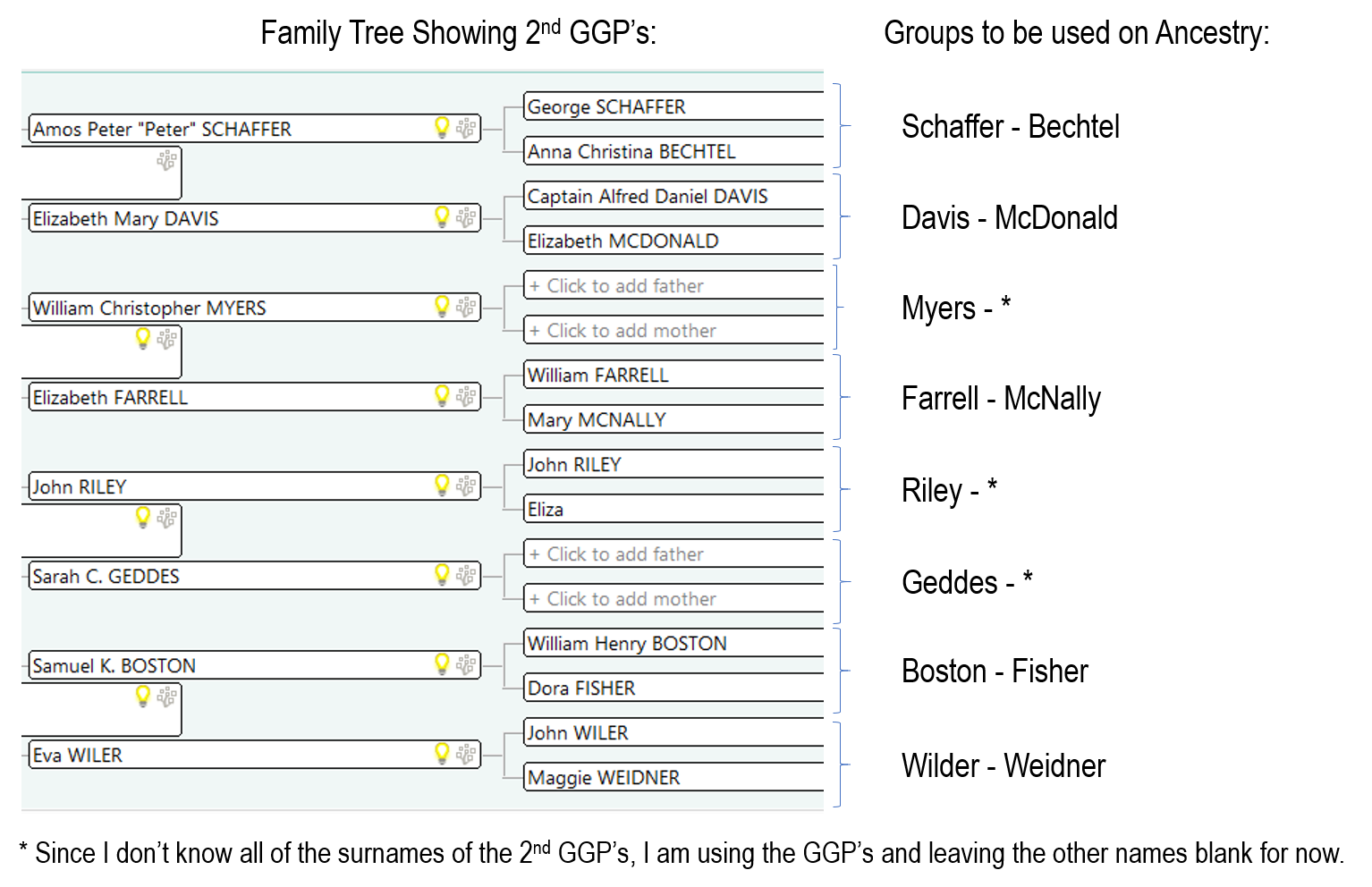
First, I look on the tree I am working on, and make eight groups from the tester’s second great-grandparents’ surnames as I know them:
Picture1

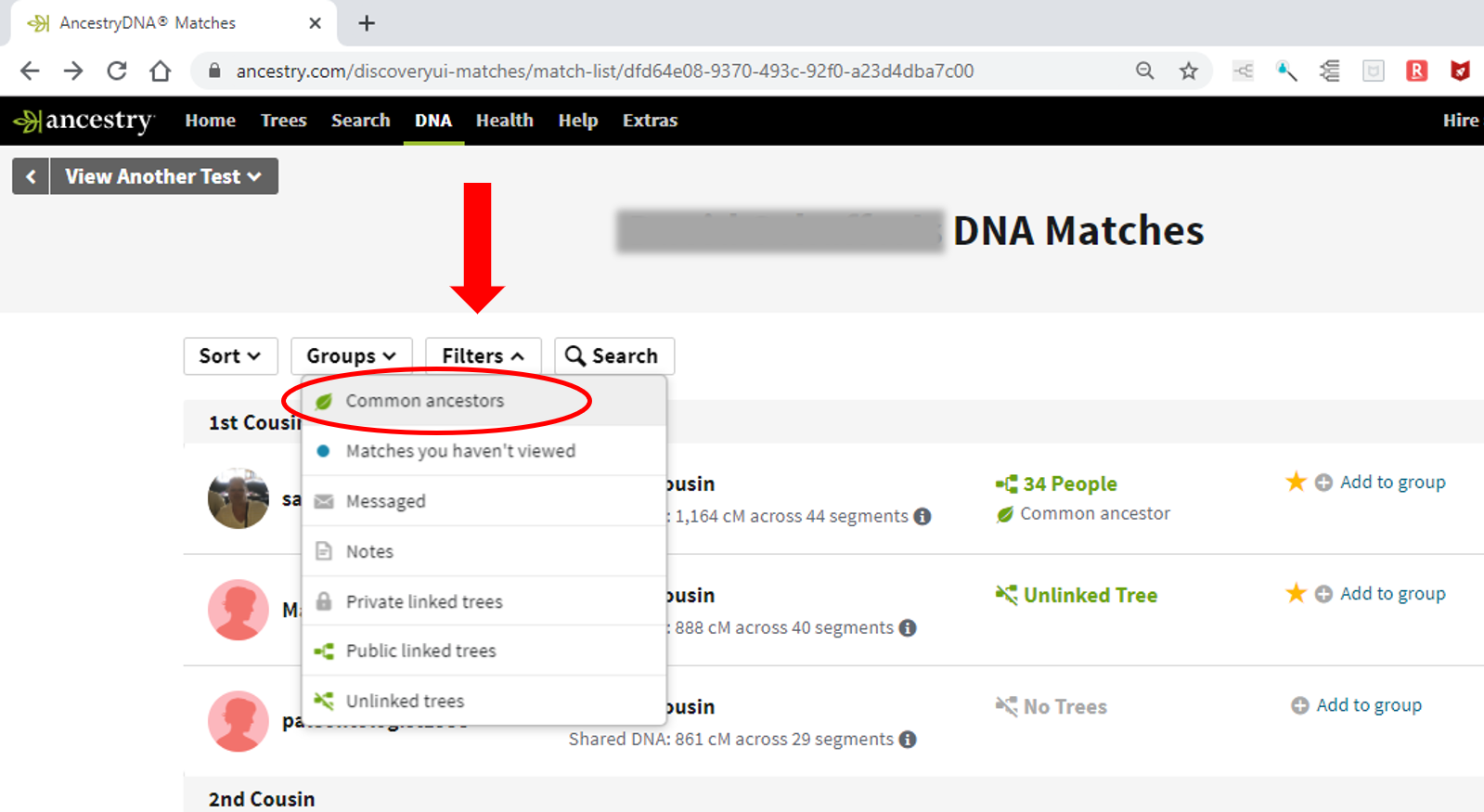
Then I open up the tester’s DNA matches in Chrome (I have found that Microsoft Edge gets a little finicky when working with Ancestry for some reason). Using the Filters tool, I pull up all of the matches that show “Common Ancestor”:
Picture2.png

Now that I have my people with common ancestors filtered, I go to the 3rd cousins. This is because I have a list of the contributor’s 2nd Great Grandparents; therefore, to attempt to get all of the names, I would theoretically start with the 3rd cousins who could be broken down into the eight sets of 2nd Great Grandparents.

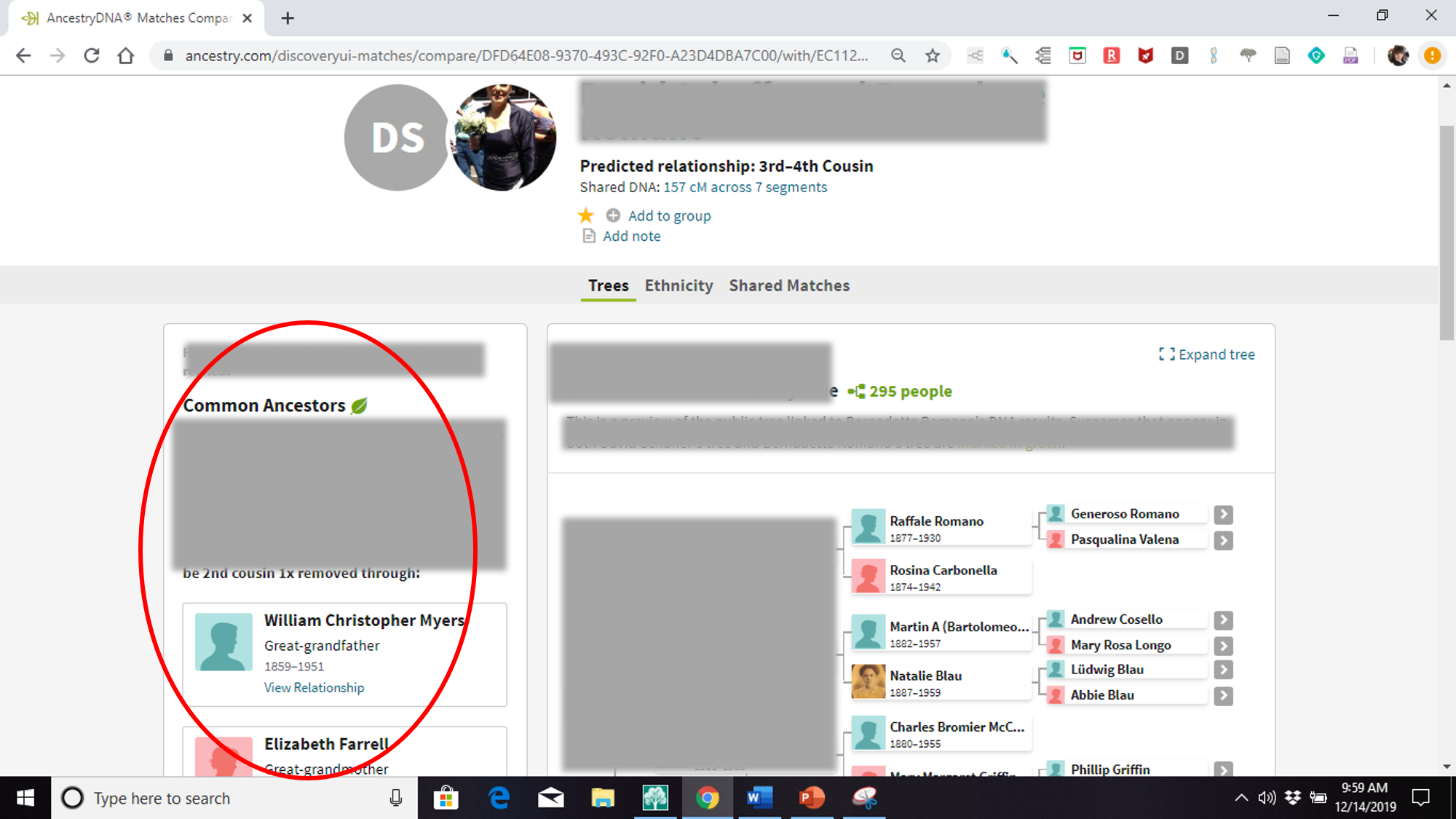
When I select the first match with a common ancestor, I look to see who the common ancestors are:
Picture3

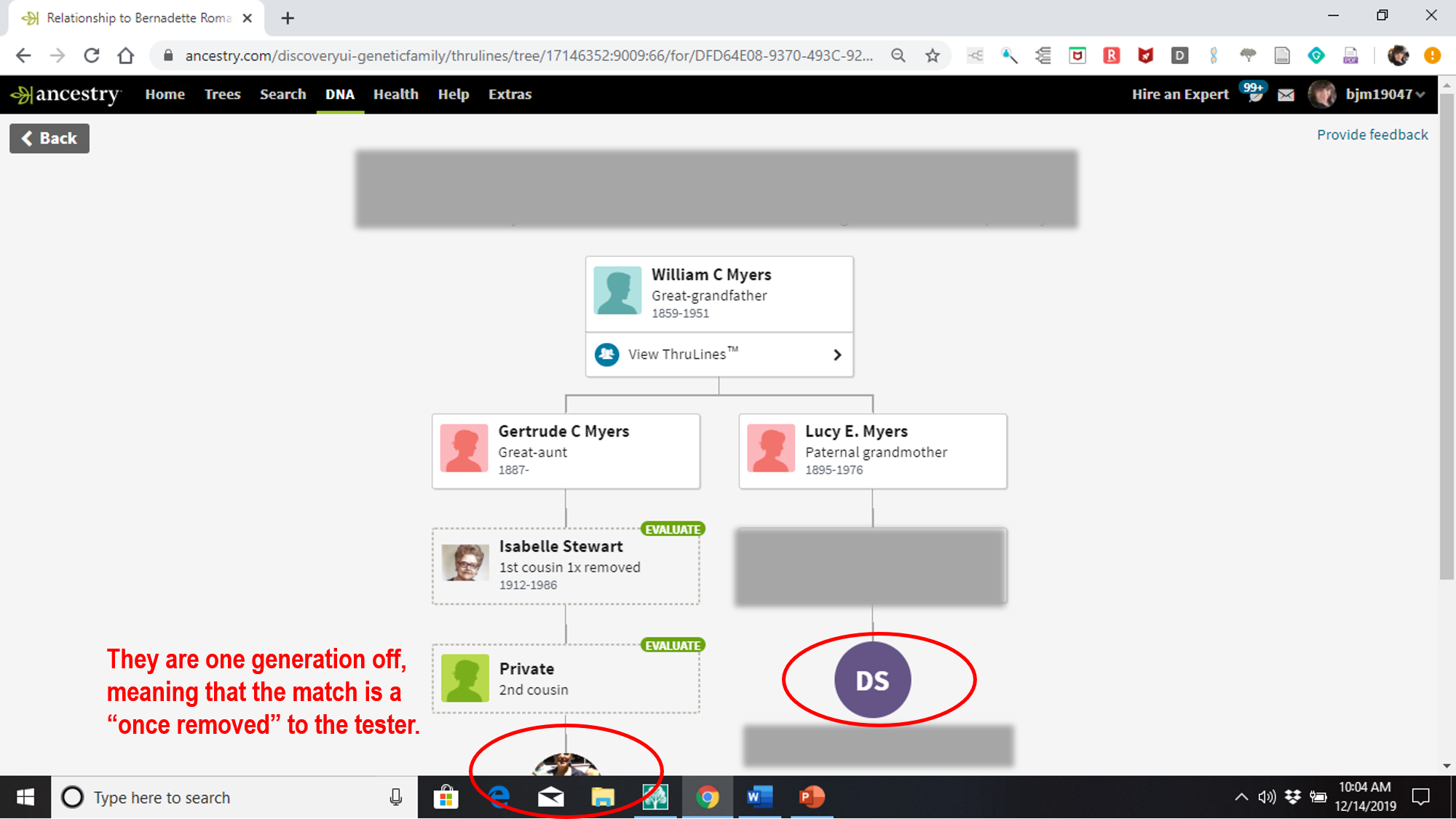
If I click on the potential common ancestor, it shows me the line of how they match:
Picture4

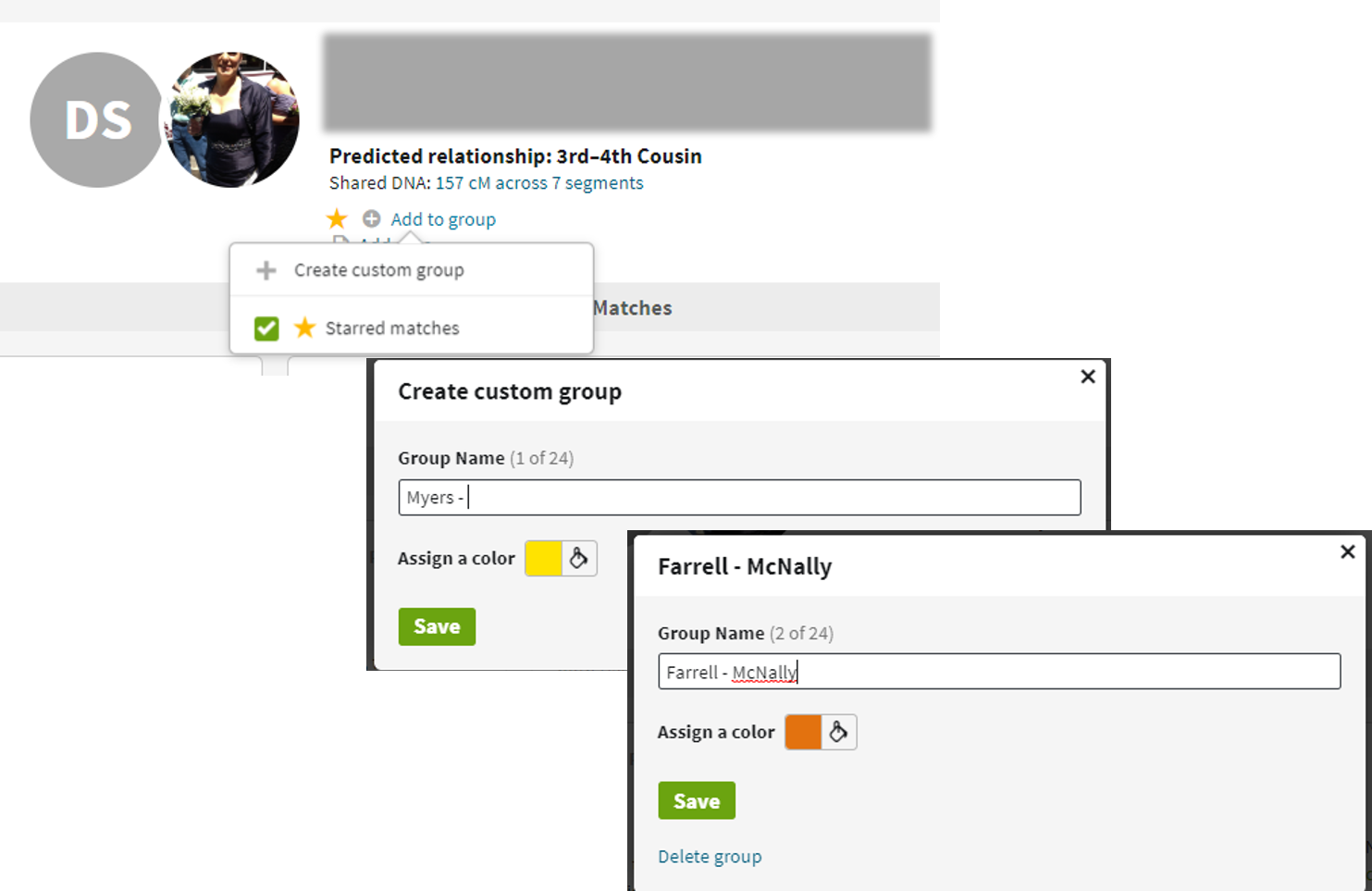
In this case, since I now know that the tester and the match are one generation off from one another, I am going to create two groups from my list: Myers – * and Farrell-McNally, and assign this match to both groups:
Picture5
Then I go to the next match and repeat the above process for each shared match with a common ancestor.

Once these are all assigned into the eight groups, I can follow the Leeds method: starting with the 3rd cousins, I can select each one not already assigned to a group and see who they share in common with the tester.

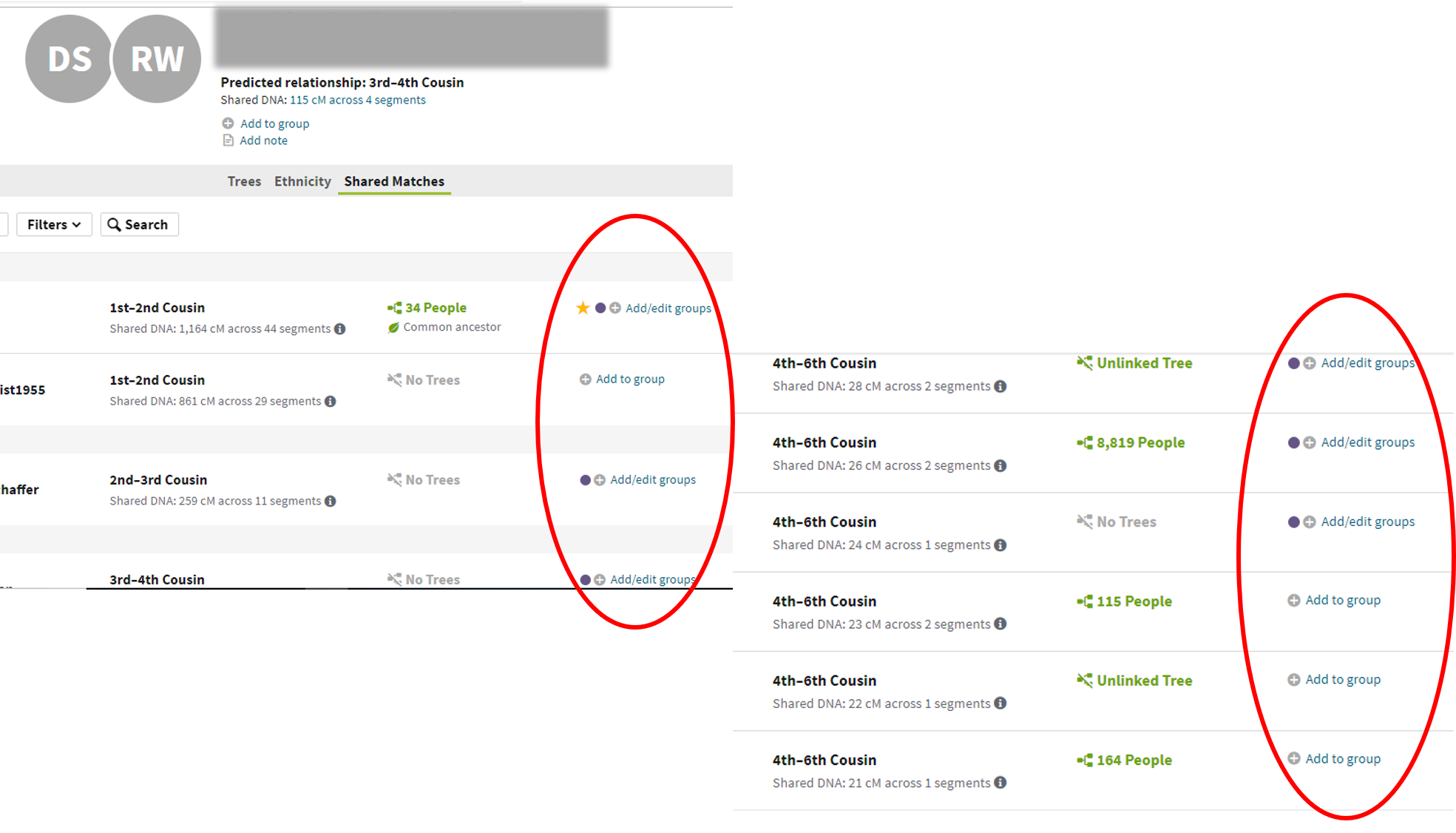
I can see from this example that most of the “in common with” matches are on one surname. So I can deduce that the other shared matches will be on that surname and can color code them accordingly:
Picture6
In this manner, I can assign the majority of the DNA matches to one of the eight groups of the tester’s 2nd Great Grandparents. By analyzing these groups, I can find clues to the missing surnames and how the matches connect to the tester. I can also validate my own research – am I on the right trail? DNA potentially tells me if I am!

Have you tried using the color coded system on Ancestry? Do you have any tricks or hacks to group them? Leave your comments below!

Posted in Uncategorized | 1 Comment

Six Degrees of Separation…and a Few Coincidences!

Have you ever played the game, “Six Degrees of Kevin Bacon”? It’s a game based on the theory that any two people are six or fewer acquaintance steps apart. But what happens when you find it in genealogy?

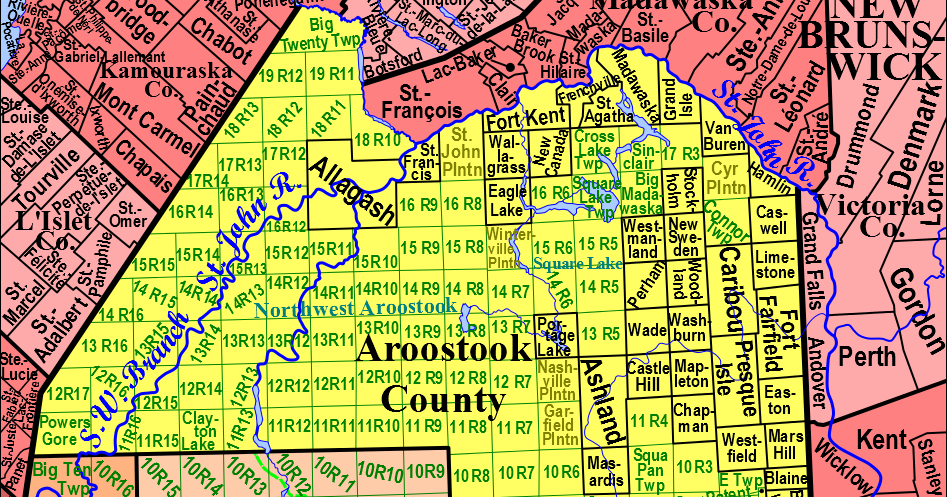
A relative on my maternal side, J.S., did their DNA and found the surprising fact that their father is not their father. After the initial shock wore off, we quietly began analyzing J.S.’s DNA matches and building out mirror trees to decipher who J.S.’s biological father is. Using Ancestry’s new “Groups” color coding feature*, I found that one DNA branch was French Canadian, and we identified J.S.’s paternal Grandmother, one Winifred Levesque. Winifred was from Maine. More specifically, she was from Van Buren, Aroostook County, Maine. That immediately rang a bell with me, because I had come across Aroostook County before. You just don’t forget a name like Aroostook. So I dug through my files, and…

ME_Aroostook_Co_towns_map

In 2008, my former boss had hired me to research his family history. His family also had French Canadian connections, and the surname, DuBay, was traced to Van Buren, Aroostook County, Maine. Sure enough, when I dug a little further back into J.S.’s tree, I found J.S. is related to my former boss!

To make matters even more interesting, I ran across another surname in J.S.’s tree: Paradis. Again, strong French Canadian ties, migrated to Maine. In the 2000’s, a cousin on my paternal side married a Paradis. I contacted my “cousin-in-law” and asked about their family history. Sure enough, they also have a connection to the Levesque family!

So Winifred has brought J.S. a full circle, dancing through my family tree in ways that I would never have imagined: first, connected to my former boss of 12 years, and then again through my cousin-in-law.

MIND. BLOWN! Six degrees of separation indeed!

*If you have NOT tried the Ancestry feature of color coding yet, I strongly urge you to watch “How to Cluster your DNA Matches With Ancestry’s New DNA Matches” on YouTube (by clicking on the link above). It will walk you through it, step by step.

Posted in Uncategorized | Leave a comment

New Polish Family Connections

Have you ever noticed with genealogy that you have no new leads for so long, and then all of the sudden, you get something amazing? This has been happening to me recently with my Polish family, and it’s been exciting!

First, I received a message from a gentleman who is cousins with my famous cousin, Jerzy Bończak. He is cousins with Jerzy on his paternal side of the family, and was able to  provide additional information on some of my relatives.

Next, I received an email from my cousin from Delaware. He had seen a photo of one of our relatives online that was credited to me and my email address, and contacted me. We met up for dinner the following week. He handed me a genealogy that he had done that lead me to a DNA match on my 23andMe profile!

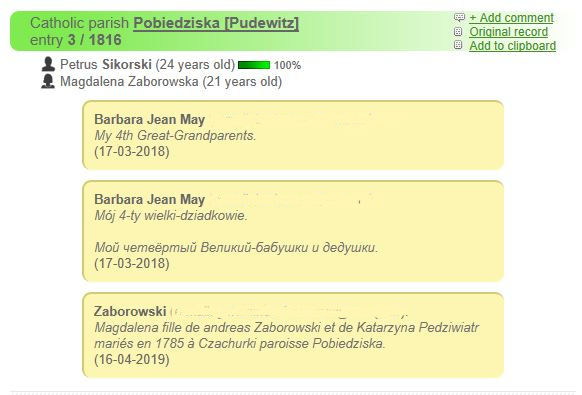
Lastly, just last night I received an email from France regarding my Sikorski line from my (6th or 7th) Cousin. I had been on The Poznan Project last year, found my 4th Great Grandparents’ marriage record, and, as I always do, I left a note on the record:

7thCousin

Sure enough, my cousin contacted me and now we are sharing information. In French. About our Polish ancestors. How wonderful is that? Which brings me to my next tip: Google Translate is an amazing tool! I can copy the email in French, paste it in, and read it in English. I can form my response in English, paste it in, and get a reasonably good translation in French. I also ran a descendant report from my genealogy software, and Microsoft Word translated the entire thing into French for me.

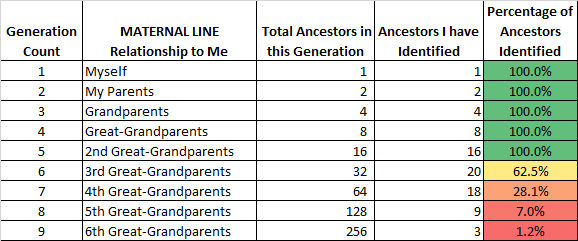
I just find it all so amazing! Five years ago, I was unable to go any further back on my Polish lines than my Great Grandparents. Today, these lines are expanding exponentially — due to advancements with DNA, Polish records becoming available online, and sometimes just a little luck and serendipity! I have “met” literally dozens of cousins online and in person that I otherwise would never have known about. I am so thankful to be able to communicate with them and share our family history. And that’s what it’s all about.

I never would have dreamed that I would be back further in time on my Polish lines than I would be on my British and German lines, but here we are. Here is the breakdown:

Image1

How many ancestors have you identified? Comment below!


Posted in Uncategorized | Leave a comment

Expanding The Leeds Method

I started playing with the Leeds Method of DNA matching a few months ago, but couldn’t quite get it to work the way I wanted it to. So, I made some slight adjustments, and wanted to share them with you.

If you are not familiar with the Leeds Method, you should read up on it here. Dana Leeds did an excellent job of creating the idea. But when I tried to apply it to my own matches, I was having some trouble visualizing. So, I set up the Leeds Method for myself, but added some extra items to it.

Please note, this is for folks with experience using MS Excel.

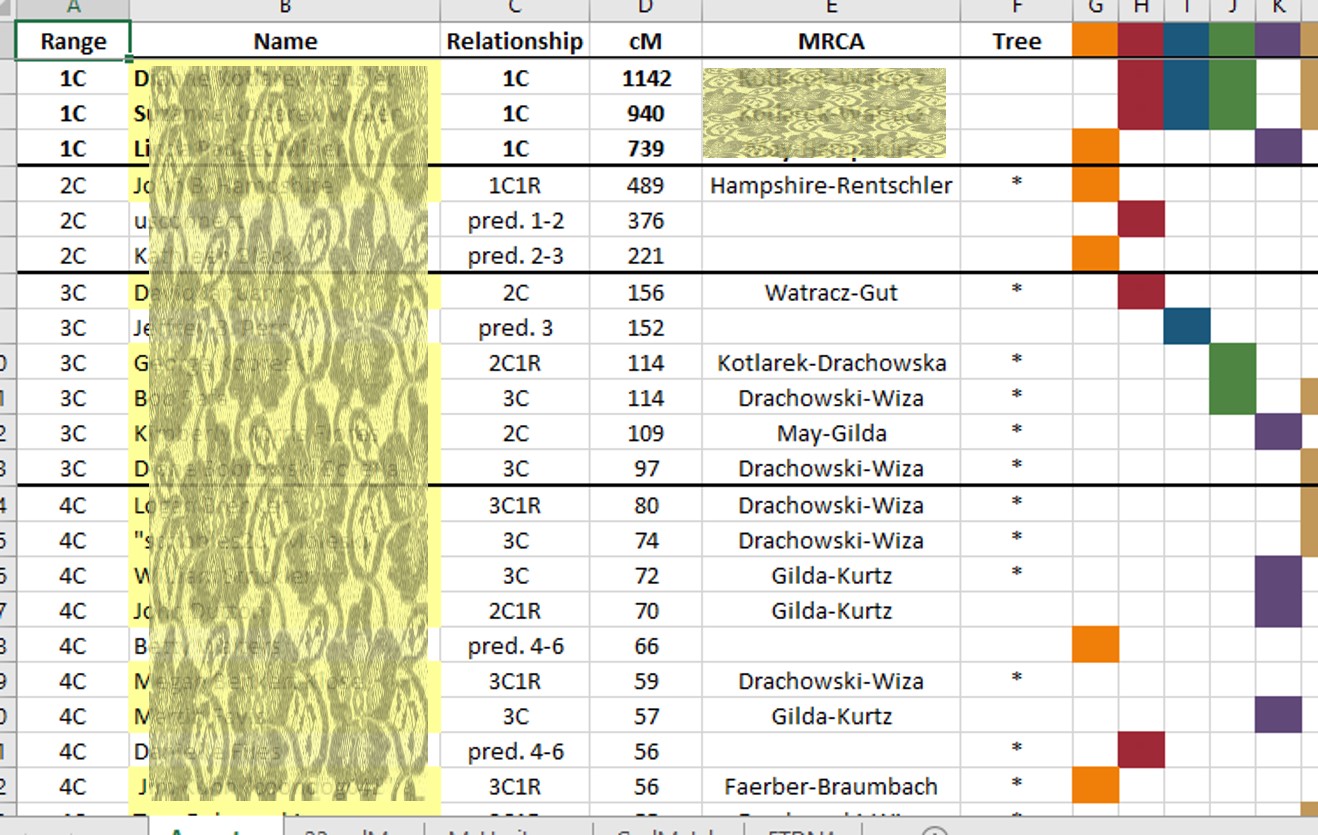
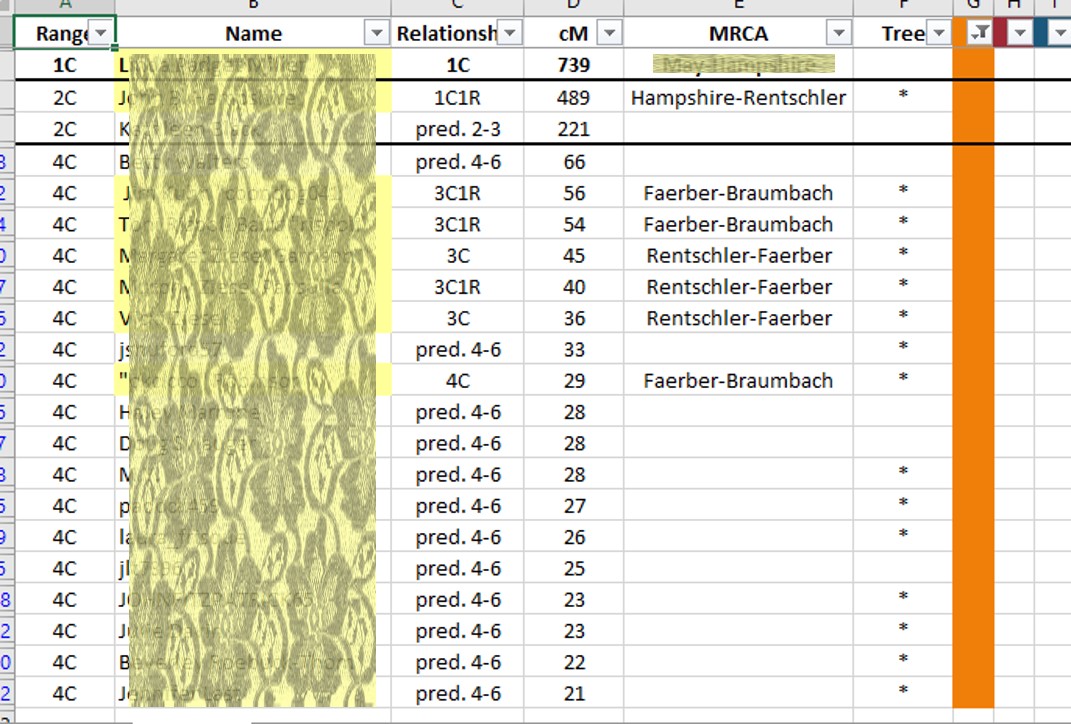
First, although the Leeds Method starts with 2nd Cousins, I decided to include 1st Cousins, but only as reference points. For some of my DNA matches, the only shared match I had with them was a 1st cousin. This let me know, at the very least, on which side of the family the rouge DNA match fell.

I then added the number of cM we shared, and if I knew the Most Recent Common Ancestor, I included that as well. I also added in our actual relationship if known.

Third, I gave the matches that I knew a pale yellow highlight. I also noted an asterisk if the match had a tree on Ancestry.com that I could see.

Picture1

Then I began Dana Leeds’ process of color coding. But I also added an asterisk in the color-coded block.

Once I color coded all my matches (through my 4th cousins), I applied the Filter feature on each color. Now, when I drop the filter to return only the matches with asterisks, I can quickly see who matches on which line of the family.

Picture2

Now I can research the matches that have online trees (the ones with the asterisks) to see if I can find where in our family tree we fit together.

There are plenty of ways to analyze our DNA matches, but I personally like the Leeds Method and DNA Painter. You can read about my experience with DNA Painter here.

Have you tried the Leeds Method? If so, comment on your experience!


Posted in Uncategorized | 1 Comment

My Civil War Ancestor

So. This happened…

Mms_2019-02-23_13_47_46_2

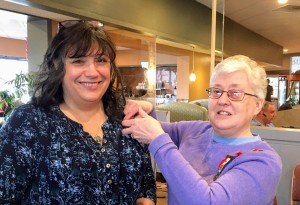
That’s me, being inducted into the Daughters of Union Veterans of the Civil War last month.  

This was something I had always hoped to find in my genealogy: An ancestor who fought in the Civil War. I didn’t think I had any since they were (mostly) fairly recent immigrants. The Civil War had always fascinated me, so it was just something I had put out of my mind of ever happening.

Then, about two years ago, I found an entry on the 1890 Veterans Schedule for my 2nd Great Grandmother, Katherine Faerber Rentschler.:

Renstchler, Catherine - 1890 Veteran's Schedules SNIPPET1

I would like to say a few things about this record. First, I wasn’t looking for it. I had no idea that my 2nd Great-Grandfather, or any of my ancestors, had served. Second, Katherine’s name is spelled differently, with a “C.” So I really wasn’t sure it was the correct George Rentschler.

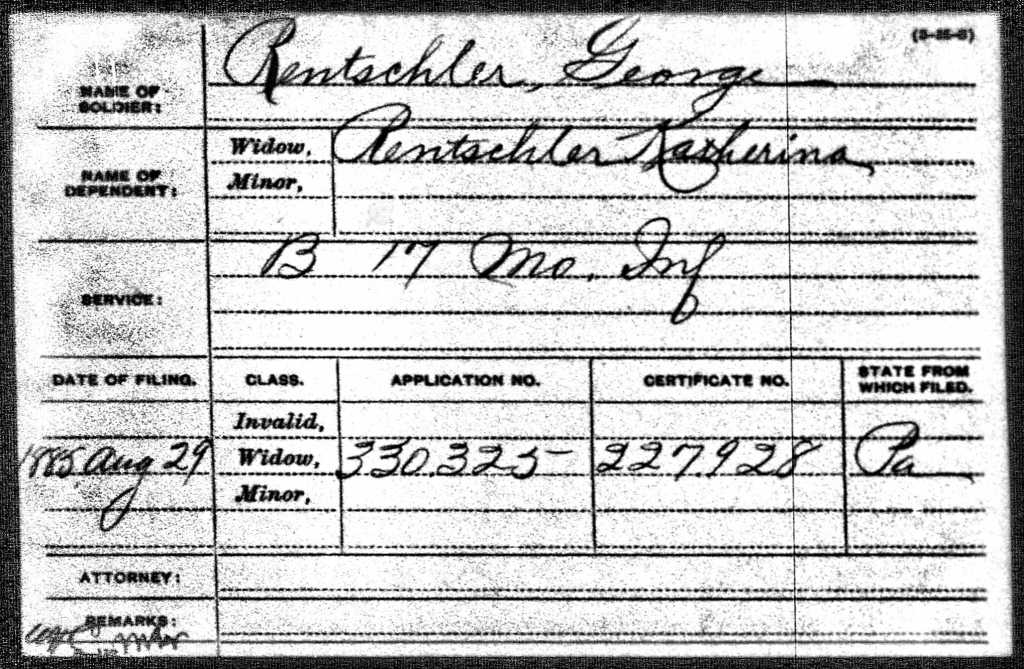
First, I looked for a George Rentschler in Bates’ “History of the Pennsylvania Volunteers.” My ancestor had lived in Philadelphia, so logic dictated that Pennsylvania was where he would have served. George did not appear in Bates’ at all. Then I checked the NPS Soldiers and Sailors Database. A George Rentschler was listed there, having served in the 17th Regiment of the Missouri Volunteers, Company B. Then I looked for the Missouri George Rentschler on Ancestry.com, limiting my search to the military files. When I found his Pension Index record, I knew I had my George from one small, tell-tale clue:

Rentschler, George - 1885 Civil War Pension Index

The “State From Which Filed” column, all the way on the right, was Pennsylvania. The Widow had filed for the pension, in August of 1885 – the month and year my ancestor had died, based on his Death Certificate.

Now we were in business. What was George doing serving in Missouri? We had no ties to the mid-west, our family was all located in Philadelphia. As I read up on the formation of Company B, I learned that it had been called “The Western Turner Rifles.” George had been a part of the Philadelphia Turners, a wood-working group, as at the time he had been a carpenter. I learned that when Missouri petitioned for volunteers, the Philadelphia Turners stepped up and sent men from their group. George joined them on September 12, 1861.

The next military file for George that I found on Ancestry.com was this:

GeoSNIP

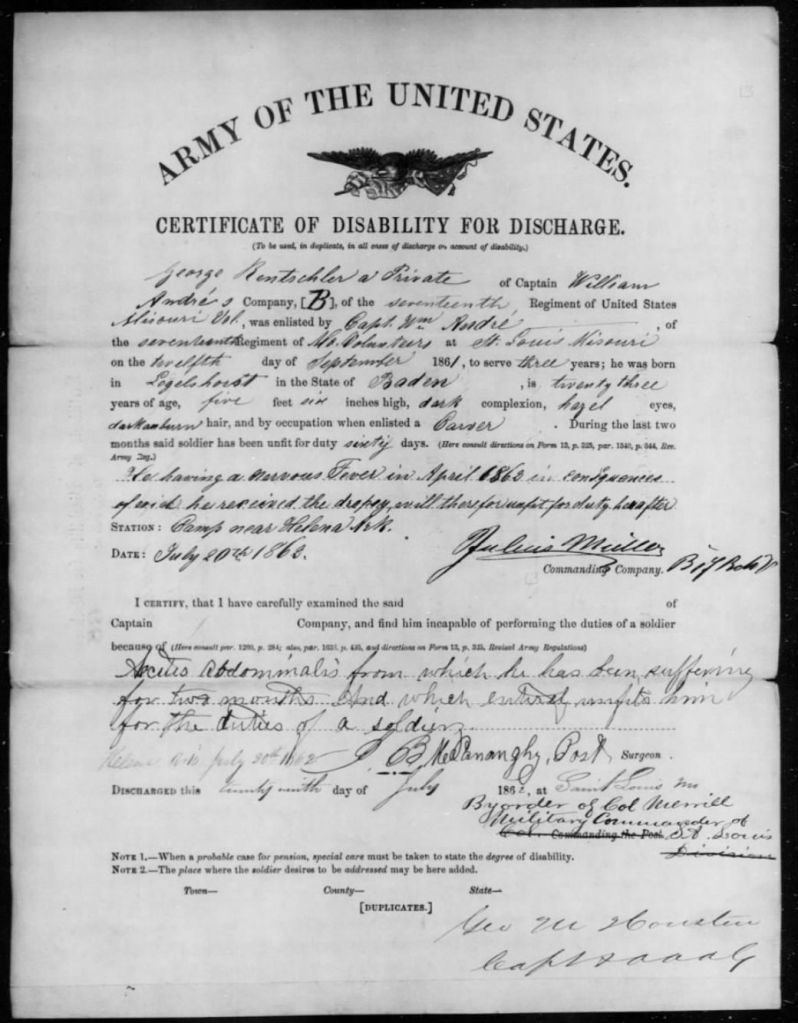
I located George’s service record on Fold 3 and learned he had a pretty rough time of things. In April of 1862, George suffered what the Army called a “nervous fever” and subsequently developed dropsy. He suffered from severe abdominal pains in an Army Hospital near Helena, Arkansas for two months.

As I read through George’s service record, I realized that, as he was laying in the hospital near Helena, he has simply been “lost” as the unit moved. George was granted an honorable discharge in July of 1862:Rentschler, George - Discharge


Now that I knew George’s story, I was ready to apply to Daughters of Union Veterans of the Civil War. Completing the application was relatively easy. When applying to a lineage society, you must have the appropriate documentation. I was a little worried that my own Birth Certificate would be a glitch, as I did not own a “full” copy (one that lists the parents’ names). But the ladies invited me to their meeting and inducted me that day in a moving ceremony. I teared up a little, thinking of how I was honoring my Civil War ancestor.

Now his service record and vital records will be preserved in my application to be a Daughter, and hopefully, future generations will be able to find him more easily.

Rentschler, George

Georg “George” Rentschler (1839-1885)


Posted in Uncategorized | Tagged , | Leave a comment